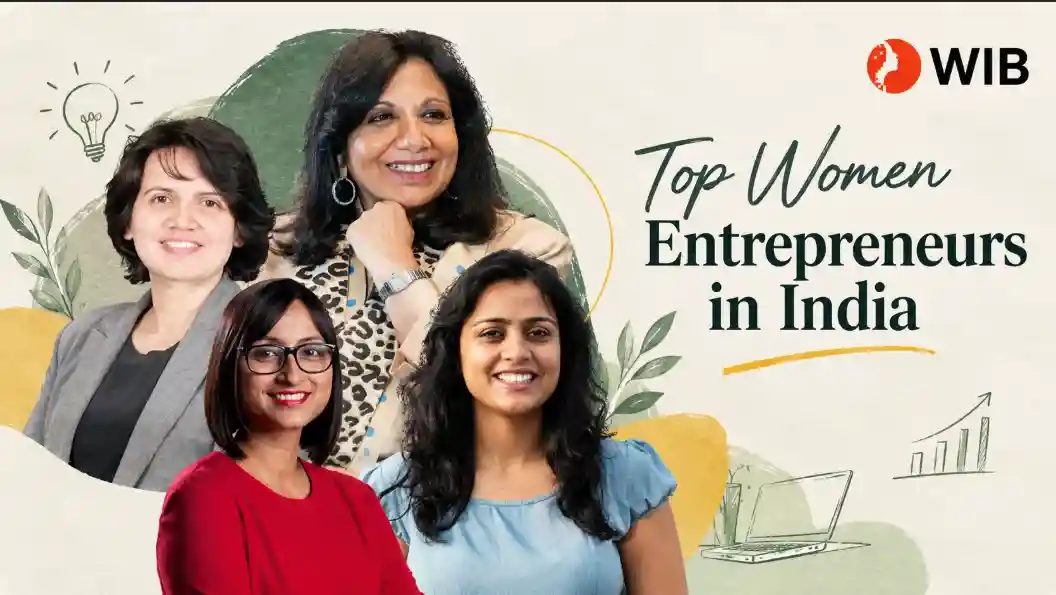
India’s entrepreneurial landscape has changed significantly over the past few decades, with women entrepreneurs in India building companies across biotechnology, technology, beauty, fintech, e-commerce, healthcare, education and consumer products.
From building a biotechnology company from a small beginning to creating major consumer brands and digital platforms, these women entrepreneurs have played an important role in shaping modern Indian business. Here are some of the prominent women entrepreneurs and business founders in India.

01
Kiran Mazumdar-Shaw — Biocon
Kiran Mazumdar-Shaw is the founder of Biocon, one of India’s best-known biotechnology companies. She began the business in 1978 at a time when biotechnology was still an emerging field in India.
Starting with a small investment, she developed Biocon into a major biopharmaceutical company with operations spanning areas such as diabetes care, biosimilars and research.
Her entrepreneurial journey is particularly notable because she entered a highly technical industry at a time when women faced significant barriers in business and science.

02
Falguni Nayar — Nykaa
Falguni Nayar founded Nykaa after spending around 25 years in the financial sector. She entered entrepreneurship at the age of 49 and built a business focused on beauty and personal-care products.
Nykaa began as an online beauty retailer and expanded into a broader beauty and lifestyle platform.
The company later became publicly listed, making Nayar one of the most prominent self-made women entrepreneurs associated with India’s consumer-internet sector. Her professional background and the development of Nykaa are also documented by Dabur, where she serves on the board.
“Starting with a small investment, she developed Biocon into a major biopharmaceutical company — entering a highly technical industry when women faced significant barriers in business and science.”

03
Anisha Singh — mydala
Anisha Singh founded mydala in 2009, a digital platform connecting consumers with deals and discounts across shopping, dining, travel and local services, at a time when India’s online deals market was still emerging.
Before turning entrepreneur, Singh worked in the United States, including with the Clinton administration on helping women entrepreneurs access funding, and later at Boston-based Centra Software, before returning to India to launch her first venture, Kinis Software Solutions.
Despite early struggles securing investment, mydala grew into a significant player in India’s online coupon and local-services market. Singh later moved into the investment ecosystem, founding She Capital to support startups led or co-led by women.

04
Vandana Luthra — VLCC
Vandana Luthra founded VLCC in 1989, beginning with a focus on beauty and wellness services. The business subsequently expanded into areas including personal care, wellness and beauty products.
Luthra is also associated with India’s skill-development ecosystem through the Beauty & Wellness Sector Skill Council. Her entrepreneurial career has made her one of the established names in India’s beauty and wellness industry.

05
Upasana Taku — MobiKwik
Upasana Taku is the co-founder of MobiKwik, a company operating in India’s digital payments and financial-services ecosystem. Before becoming an entrepreneur, Taku worked in the technology and payments sector.
She later co-founded MobiKwik with a focus on digital payments and financial services. Her career represents the growth of women founders in India’s fintech industry. MobiKwik subsequently became a publicly listed company.
The Embassy of India in Bucharest also identifies Taku as MobiKwik’s co-founder, executive director and CFO.

06
Ghazal Alagh — Mamaearth
Ghazal Alagh co-founded Mamaearth with Varun Alagh. The company developed a range of personal-care products and built its initial presence through a direct-to-consumer business model.
Mamaearth later became part of Honasa Consumer, which expanded its portfolio of consumer brands.
The company’s growth is an example of how India’s expanding digital-commerce ecosystem created opportunities for new consumer brands. Startup India has highlighted Mamaearth among major Indian D2C companies co-founded and led by women.

07
Vineeta Singh — SUGAR Cosmetics
Vineeta Singh is the co-founder and CEO of SUGAR Cosmetics, an Indian beauty brand that developed a strong presence among younger consumers. The company combined online sales with an expanding offline retail network.
Singh has also become widely recognized for her role in India’s startup ecosystem through her public appearances and participation in entrepreneurship-focused programmes. The Embassy of India lists Singh among notable Indian women entrepreneurs and identifies her as CEO of SUGAR Cosmetics.

08
Richa Kar — Zivame
Richa Kar founded Zivame, an online lingerie and intimate-wear platform. The company addressed a relatively underserved category in Indian e-commerce and offered customers the ability to shop for intimate apparel online with greater privacy and access to a wider range of products.
Kar’s entrepreneurial journey is an example of how founders identified opportunities in categories that were traditionally difficult to address through conventional retail.

09
Aditi Gupta — Menstrupedia
Aditi Gupta co-founded Menstrupedia, an educational initiative focused on menstrual health and puberty education. The project began with the aim of making information about menstruation easier for young people to understand.
Its comic-based educational approach helped introduce menstrual-health discussions in schools and communities. Her work demonstrates that entrepreneurship can also address social and educational challenges rather than focusing exclusively on conventional commercial markets.
The Embassy of India lists Aditi Gupta as the co-founder of Menstrupedia Comic.

10
Kalpana Saroj — Kamani Tubes
Kalpana Saroj is a prominent entrepreneur associated with Kamani Tubes. Her business career is notable because she became involved in reviving a financially troubled industrial company and subsequently became associated with its turnaround.
Her story is frequently discussed in the context of entrepreneurship, business recovery and overcoming social and economic barriers.
What These Women Entrepreneurs Have in Common
These entrepreneurs come from very different industries, but their careers demonstrate several important trends in Indian business.
Building businesses in different sectors
Women entrepreneurs are no longer concentrated in a single industry. The examples above span biotechnology, software, fintech, beauty, e-commerce, manufacturing and education.
Identifying underserved markets
Several of these businesses were built around gaps in existing markets. Nykaa focused on organised beauty e-commerce, Zivame addressed online intimate-wear shopping, while Menstrupedia focused on accessible menstrual education.
Combining technology with traditional industries
Digital platforms have allowed entrepreneurs to enter sectors that previously depended heavily on physical retail. Consumer brands such as Mamaearth and SUGAR Cosmetics illustrate how digital-first businesses can develop into broader consumer companies.
Creating opportunities for other women
The visibility of successful women founders has also contributed to a broader conversation about women’s participation in entrepreneurship, leadership and technology.
Government data highlighted by Startup India shows that women-led startups have expanded significantly in several D2C sectors. As of May 2023, Startup India reported 3,644 women-led startups across three major D2C sectors — personal and home care, food and beverages, and fashion.
What We Can Learn From Their Journeys
The stories of these women entrepreneurs show that there is no single path to building a successful business. Some started companies in industries that were still emerging, while others identified gaps in established markets and created new opportunities.
Their journeys highlight the importance of taking calculated risks, understanding changing consumer needs, adapting to technology, and staying committed to a long-term vision.
From biotechnology and technology to beauty, fintech, e-commerce and social entrepreneurship, their experiences also show the diversity of opportunities available to women in India’s business ecosystem.
For aspiring entrepreneurs, these stories can serve not as a formula for success, but as examples of different ways an idea can be transformed into a business.
WIB · Women In Business
Empowering Women. Building Visibility. Creating Opportunities.
Women in Business (WIB) is India’s largest network of women entrepreneurs, connecting, showcasing, and supporting women entrepreneurs, founders, professionals, freelancers, and small business owners across India. We believe every woman building something of her own deserves visibility, recognition, meaningful connections, and opportunities to grow.
Through our entrepreneur directory, editorial features, magazines, digital platforms, and collaborations, WIB gives women-led businesses a platform to be seen, connect with others, and discover new opportunities. Our mission is to build a strong, connected ecosystem for women in business across India, bringing together women, businesses, ideas, and opportunities.